

Contenido:
Toggle 16min read
 Evidence-based
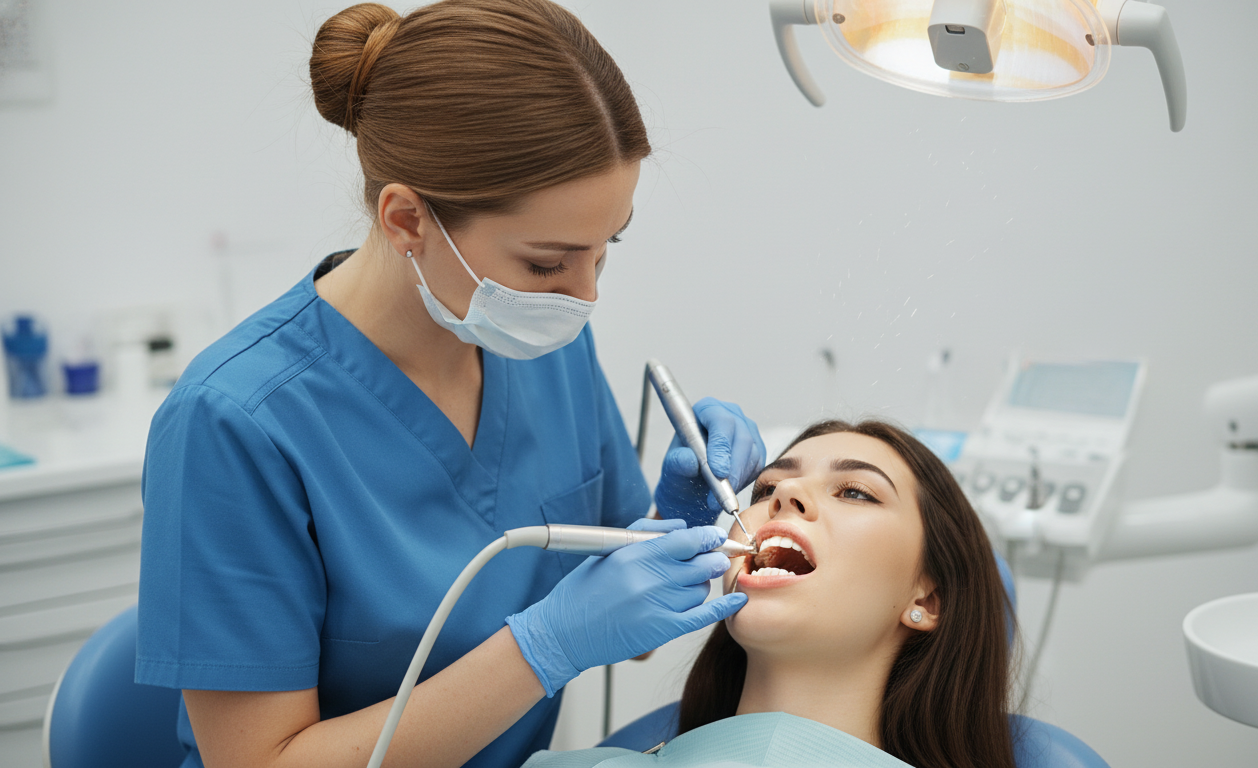
Can veneers be removed? Yes, both ceramic and composite veneers can be safely taken off when the procedure is performed by a trained cosmetic dentist. For ceramic veneers, the recommended method is laser-assisted removal using an erbium laser, which targets the resin cement without damaging the underlying tooth structure. For composite veneers, the ideal approach is slow-speed bur removal guided by a UV lamp, which shows exactly where the resin ends and the natural tooth begins. What should never happen, under any circumstances, is attempting veneer removal at home — the risk of irreversible tooth fracture and nerve damage is real and serious
Can Veneers Be Removed? The Truth Most Dentists Won’t Tell You
Can veneers be removed? It’s one of the most important questions I hear in my practice and one that deserves a direct, honest answer. Whether you’re considering ceramic veneers for the first time and want to understand your options, or you already have veneers that need replacing, the answer is the same: yes, they can come off. But how they’re removed determines everything — the health of your teeth, what you can do afterward, and how your smile looks for years to come.
After more than 16 years in cosmetic dentistry and over 200 veneer procedures per month here in Medellín, I’ve seen what happens when veneer removal is done correctly and the consequences when it isn’t. In this post, I’m going to walk you through every detail of the process: what’s involved for each type of veneer, why the technology matters, what your teeth look like afterward, and why no one should ever attempt this at home.
I’m Dr. Sara Peláez, founder of Clínica Viena in Medellín, Colombia. I graduated in 2009 from the Universidad CES, one of the most prestigious dental schools in the country and I’ve built my practice on one principle: minimal intervention, maximum results. What I’m sharing here is exactly what I tell every patient who walks through my door.
Why Would Someone Want to Remove Their Veneers?
Before we get into how veneer removal works, it’s important to understand why it becomes necessary in the first place. In my experience, patients arrive with this question for a few distinct reasons — and the reason shapes the entire clinical approach.
1. Old veneers that need a refresh
The most common scenario I see is a patient who had veneers placed 10 to 15 years ago — sometimes with more enamel removed than was necessary — and now the veneers are worn, stained, or simply no longer reflect their aesthetic goals. They want a new smile design, and removal is the logical first step.
2. Veneers placed with errors
The second scenario is patients who come to me after having veneers done elsewhere, where the result wasn’t right: poor adaptation at the margins creates microscopic spaces where food and bacteria accumulate, causing chronic bad breath. Bite issues were never corrected. Materials were substandard. In these cases, removing the veneers and starting over isn’t just cosmetically desirable — it’s clinically necessary.
3. Composite veneers ready for an upgrade
A third scenario — and one I see increasingly with international patients — is someone who had composite veneers placed 3 to 6 years ago and is now ready to upgrade to ceramic. Composite is a great starting point, but it stains, it wears, and it doesn’t have the lifespan or aesthetic depth of porcelain. Knowing how composite comes off safely is essential for this transition.
4. Aesthetic change of mind
Occasionally, a patient changes their mind about color or shape. This is rare when the process is done right — at Clínica Viena, we do a full digital trial and resin mockup before preparing a single tooth — but it happens. And when it does, there’s a protocol for it.
How Are Ceramic Veneers Removed?
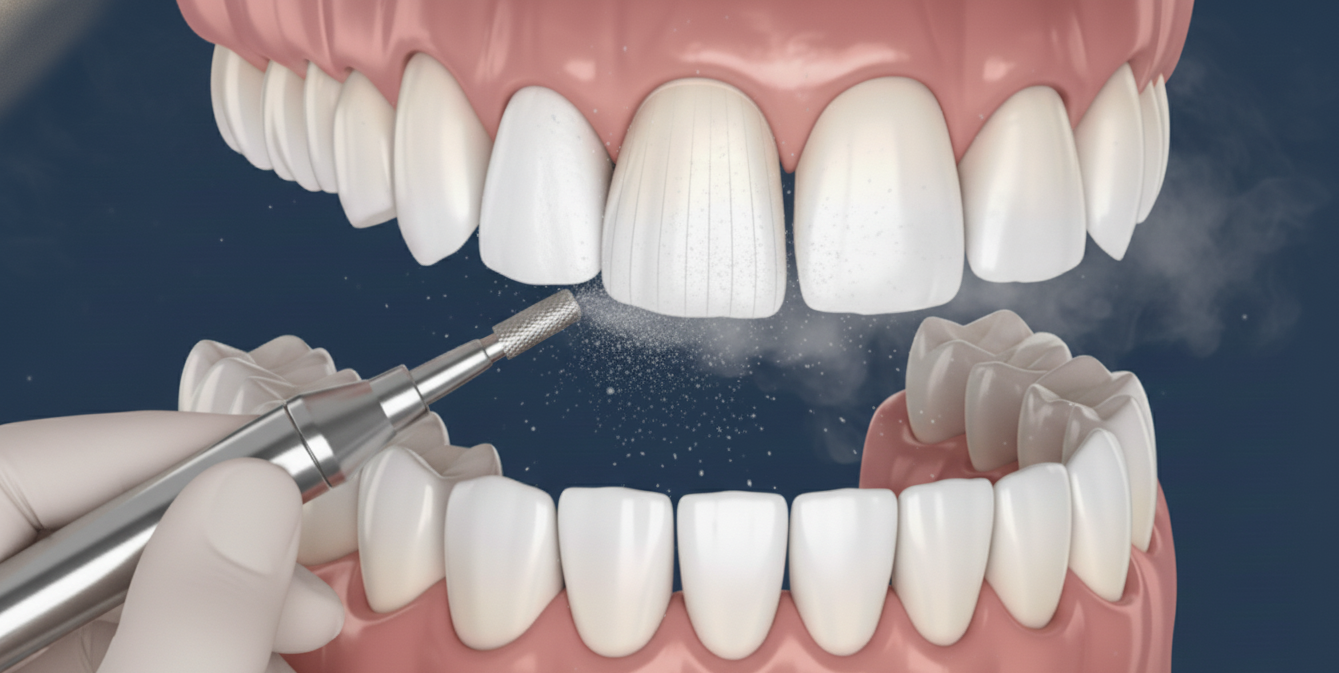
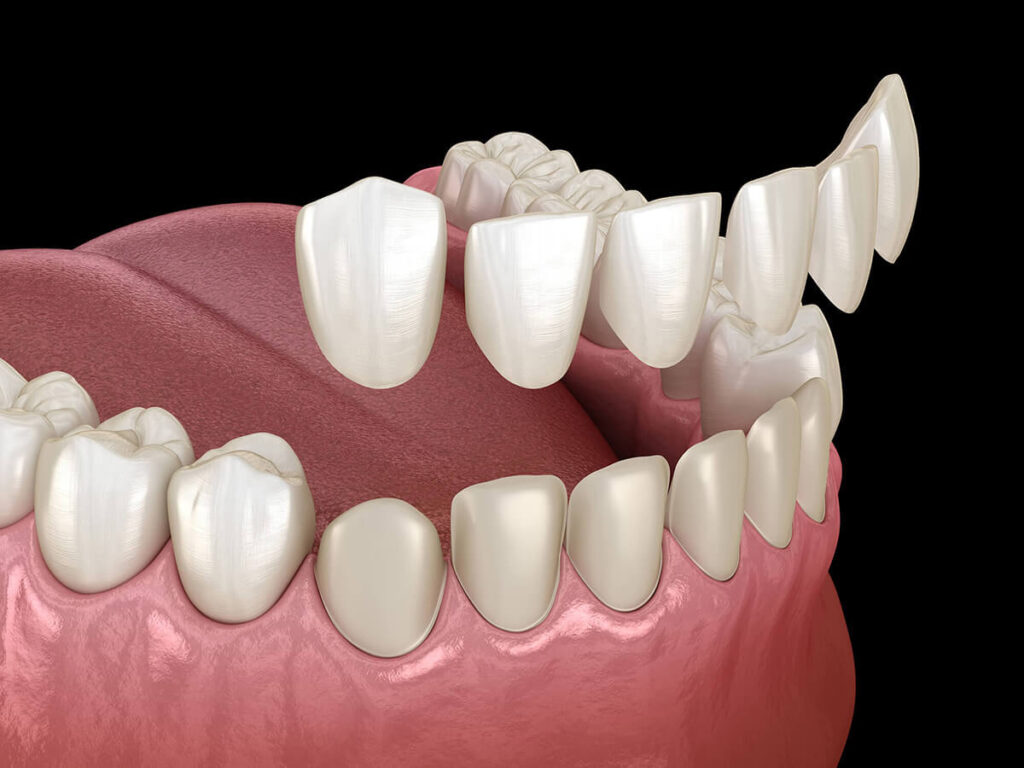
Ceramic veneers — whether made from e.max, feldspathic porcelain, or amber press — are bonded to the tooth with a resin cement engineered to last for decades. That’s the whole point. But when removal becomes necessary, that bond has to be broken safely and precisely.
Method 1: Laser Removal — My First Choice for 4 or More Veneers
At Clínica Viena, the method I recommend for any case involving 4 or more ceramic veneers is laser-assisted debonding using an erbium laser (Er:YAG). The laser energy is absorbed by the resin cement layer — not by the ceramic or the tooth structure. The cement undergoes thermal softening or carbonization, dramatically reducing its bond strength. The veneer separates cleanly, often in one piece.
A systematic review and meta-analysis published in the Journal of Prosthetic Dentistry (2024) confirmed that erbium lasers produce a significant and immediate reduction in the shear bond strength of ceramic veneers. Critically, with proper laser settings, the underlying tooth structure is not damaged during the process. A 2026 study on ultrafast laser technology further demonstrated that the internal dentin remains unaffected, preserving tooth bioactivity — and that carbonization mode is the most efficient approach for veneer removal.
The key clinical advantage of laser over rotary bur is temperature control. A rotating bur working on a hard ceramic surface generates significant friction heat. That heat travels through the veneer and into the underlying tooth structure. Over multiple veneers, in a single session, the cumulative thermal exposure can cause nerve damage — sometimes months after the procedure. With laser, pulp temperature is actively managed by adjusting parameters and scanning strategy. The heat risk is essentially eliminated.
Method 2: Bur Removal — Acceptable for 1 to 2 Veneers
For a single veneer or two, careful removal using a low-speed handpiece and a calibrated bur is clinically appropriate. The key is technique: low speed, high patience, and a practitioner who knows the material. A skilled cosmetic dentist can remove a ceramic veneer this way without compromising the enamel beneath.
Where I see problems — and I see them regularly in patients arriving from other clinics — is when a high-speed handpiece is used for ceramic veneer removal because it’s faster. It is faster. But ceramic is one of the hardest materials used in dentistry. The friction and vibration of a high-speed bur on ceramic creates heat that can cause micro-fractures inside the tooth and, in serious cases, irreversible pulp inflammation requiring endodontic treatment. This isn’t theoretical. I’ve treated these patients.
Tap any row to read Dr. Sara's clinical note
| Factor | Laser (Er:YAG) | Bur removal |
|---|---|---|
| Recommended for
Dr. Sara's noteWhen removing a full smile set — 8, 10, 12 veneers — the cumulative heat from bur removal over that session is a real clinical risk. Laser eliminates that variable completely.
|
4 or more veneers | 1 to 2 veneers |
| Heat generated
Dr. Sara's noteCeramic is one of the hardest materials in dentistry. A high-speed bur working against it creates friction heat that travels straight into the tooth. With laser, we actively control the temperature throughout the session.
|
Very low — controlled by laser parameters | Significant — especially at high speed |
| Risk to dental nerve
Dr. Sara's noteI've seen patients arrive with post-removal nerve damage from bur technique done too fast. It doesn't cause immediate pain — it shows up months later as sensitivity or pulpitis. Laser removes that risk entirely.
|
Minimal with correct settings | Moderate to high if rushed |
| Speed
Dr. Sara's noteBecause the laser weakens the cement bond, the veneer often lifts off in one piece. With a bur you're grinding through the ceramic itself — which takes much longer and destroys the restoration in the process.
|
Faster — veneer often comes off intact | Slower — ceramic is extremely hard |
| Enamel preservation
Dr. Sara's noteThe laser energy targets the resin cement, not the tooth. The enamel underneath is essentially untouched after removal — which is exactly what I want going into a new bonding procedure.
|
Excellent — laser targets cement, not tooth | Good when done carefully at low speed |
| Available at Clínica Viena
Dr. Sara's noteWe invested in erbium laser technology specifically because of veneer removal cases. For any multi-veneer session, it is always our first choice — it's faster, safer, and gives the tooth the best possible surface for rebonding.
|
✓ Standard protocol | ✓ For indicated cases |
Dr. Sara Peláez Monsalve · Clínica Viena · Medellín, Colombia
How Are Composite Veneers Removed?
Composite veneers are made of resin — a softer material than ceramic — which makes them easier to remove in theory. But there’s a critical challenge that most patients and even some clinicians underestimate: composite looks almost identical to natural tooth structure under standard clinical lighting. Without the right diagnostic tool, there is no reliable way to know where the resin ends and the enamel begins. And if you keep removing material past the resin, you’re taking the patient’s own enamel with it.
The UV Lamp: Our Precision Tool for Composite Removal
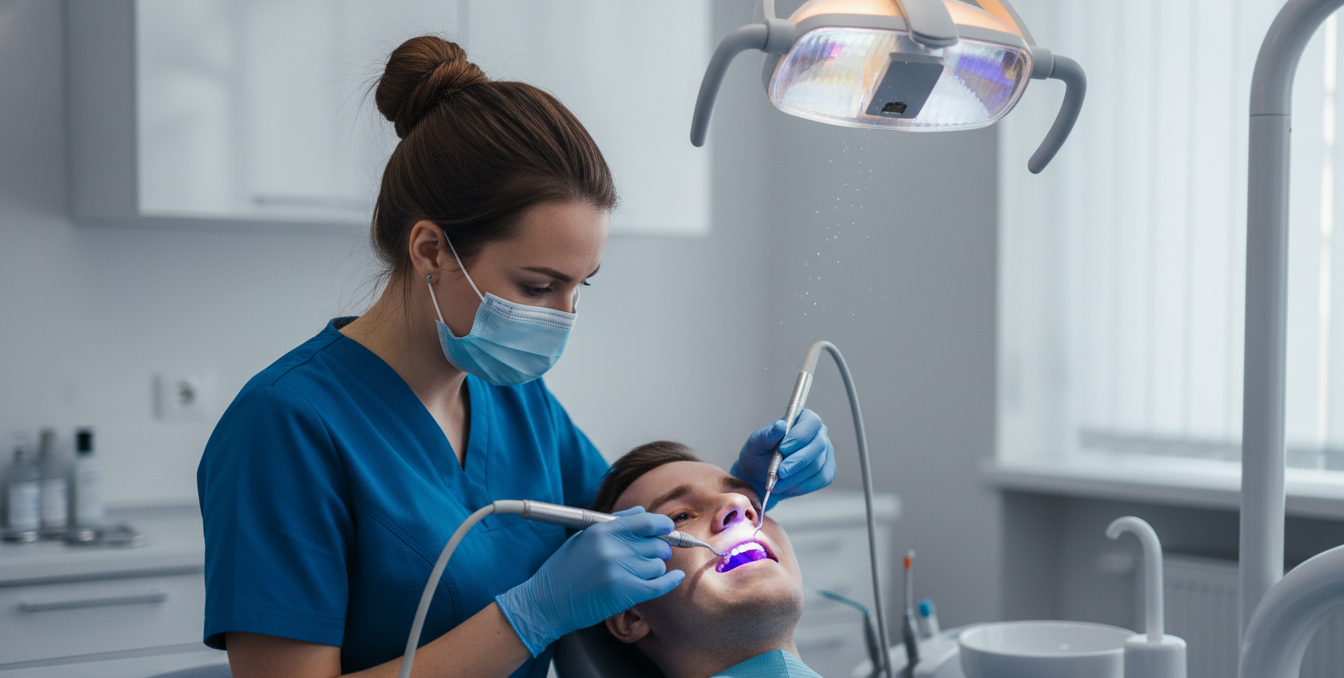
At Clínica Viena, we use a UV diagnostic lamp during all composite veneer removals. Under ultraviolet light, composite resin fluoresces differently from natural tooth structure — the boundary between them becomes clearly visible. This transforms what would otherwise be a process based on estimation and feel into a precise, controlled, and verifiable procedure.
The removal itself is done with a low-speed handpiece and a fine-grain bur, working incrementally and checking under the UV lamp at every stage. The dentist removes resin, verifies the boundary, removes more, verifies again. It is painstaking. For a full set of composite veneers, this process can take 2 to 3 hours. But those hours protect something that cannot be replaced: your natural enamel.
Why Laser Isn’t the First Choice Here
It’s worth clarifying: while laser is the ideal tool for ceramic veneer debonding, it is not as effective as the primary method for composite veneer removal. The resin material responds differently to laser energy than ceramic cement does, and the efficiency advantage that makes laser so compelling for ceramics doesn’t translate as directly to composite resin. Slow-speed bur with UV lamp guidance is the correct protocol for composite — and this is what we use.
The Problem Nobody Talks About: Over-Contoured Composite Veneers
This is something I feel strongly about, because I see it in my practice constantly — and it causes real, preventable damage. Over-contouring happens when the dentist builds composite resin over or below the gumline instead of ending precisely at the natural gingival margin. The result looks fine — impressive, even — on the day of placement. But it’s a time bomb for the patient’s dental health.
Here’s what I see 3 to 5 years later when those patients come to me:
- Chronic gum inflammation and bleeding that doesn’t respond to regular cleanings
- Bone loss around the affected teeth due to sustained gingival irritation from the subgingival resin
- Dental mobility — the teeth begin to feel loose because the supporting bone and ligament have been compromised
- In extreme cases: root canals, and in the worst scenarios, tooth extraction
A peer-reviewed systematic review published in Clinical Oral Investigations confirmed that subgingival restoration margins are directly associated with higher rates of periodontal breakdown. The aesthetic gain at placement becomes a long-term liability for oral health
What You Should Never Do: Home Veneer Removal
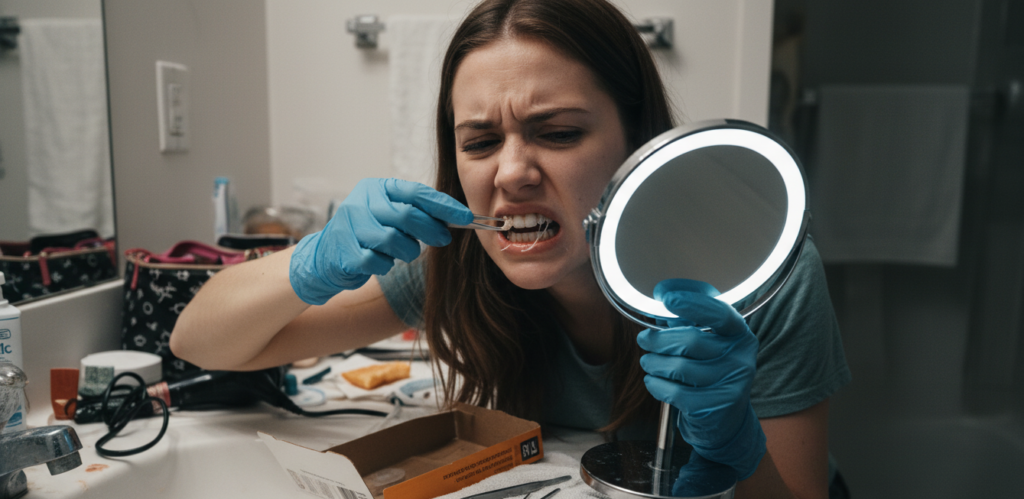
I want to be direct about this because it comes up more than you’d think — especially with the rise of dental DIY content online. Attempting to remove veneers at home is not “not ideal.” It is genuinely dangerous.
Veneers are bonded with resin cement engineered to withstand years of chewing force. Trying to pry or break them off manually places enormous stress on the tooth structure. The most common outcome isn’t that the veneer comes off cleanly — it’s that the tooth fractures. Sometimes at the crown level, sometimes at the root. These fractures are not always immediately painful. They may feel stable for weeks or months. And then, as the crack propagates, the patient discovers — often in an emergency — that a tooth they thought was fine is no longer saveable.
Additionally, without UV diagnostic equipment, it is impossible to know where composite ends and natural enamel begins. Any attempt to grind or scrape at home will remove enamel. Enamel does not regenerate. The damage is permanent.
Why We Invested in Laser Technology for Veneer Removal
When I decided to incorporate erbium laser technology at the clinic, one of the primary clinical indications was ceramic veneer removal. I had seen too many cases — both in my own practice and in patients arriving from other providers — where bur removal of large veneer sets had caused thermal damage that presented months later as sensitivity, nerve complications, or failed new restorations.
The clinical logic is straightforward: when you’re removing 8, 10, or 12 ceramic veneers in a single session using a rotary bur, the cumulative heat exposure over that extended period is significant. Laser eliminates that variable. The bond breaks through the laser’s effect on the cement, and the tooth structure underneath is essentially untouched. Scientific evidence from the Journal of Prosthetic Dentistry and from Lasers in Medical Science (2023) consistently shows that erbium lasers do not promote significant enamel changes during ceramic veneer debonding — a finding that cannot be replicated with conventional rotary instruments.
For our international patients — most of whom travel from the United States and are combining multiple procedures in a single visit to Medellín — this matters enormously. Every tooth that goes through laser removal at our clinic is in better structural condition for the subsequent veneer bonding. The quality of what goes on top is always determined by the quality of what came before.
What Happens to Your Teeth After Veneers Are Removed?
This is where the original preparation becomes decisive. And this is the conversation I wish every patient had before getting their first set of veneers — because the decision made at the preparation stage has consequences that last decades.
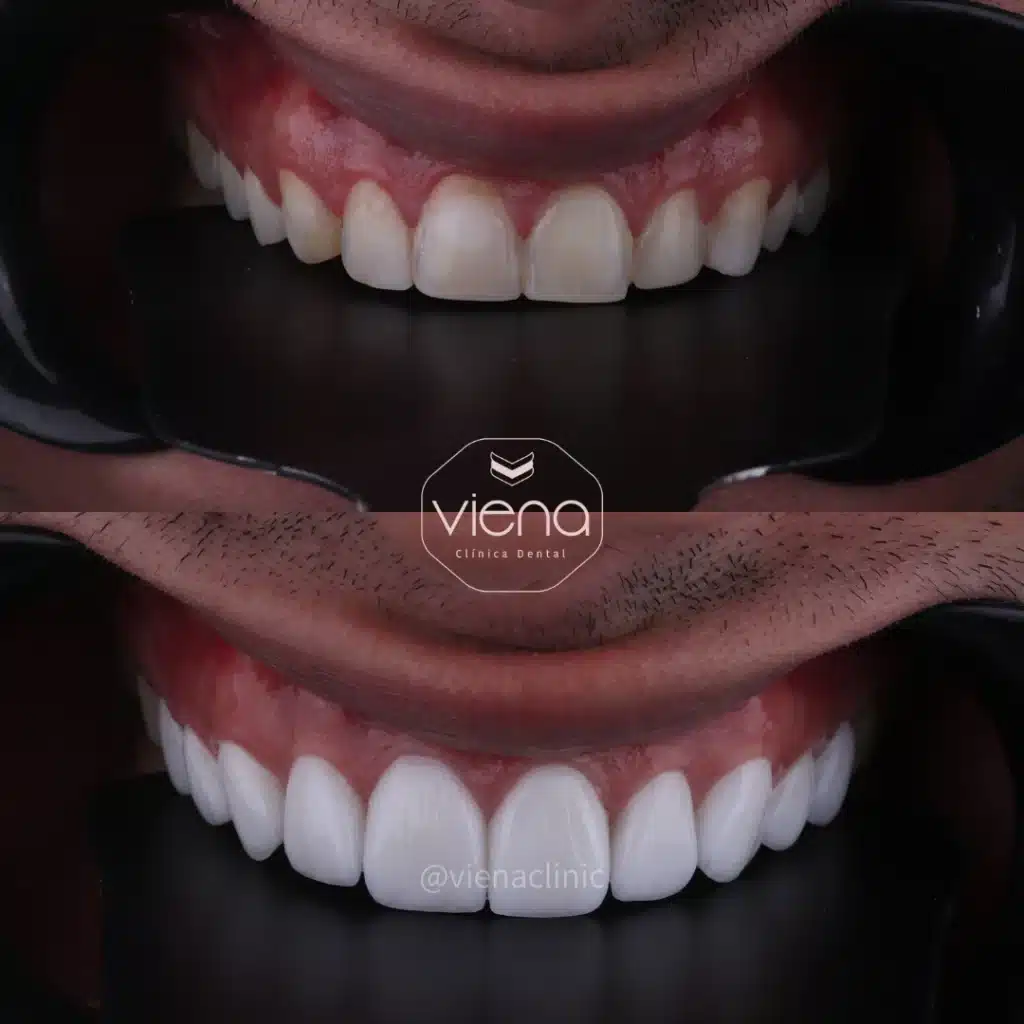
At Clínica Viena, my standard preparation involves a reduction of only 0.2 to 0.7 mm of enamel. This is intentionally conservative. It allows the veneer to sit naturally on the tooth without bulk, and it preserves enough enamel that if the veneers ever need to come off, the underlying teeth remain functional and structurally sound.
When those veneers are removed with our laser protocol, what remains is a tooth with minimal surface irregularity from the prep and any residual cement. Small composite restorations at the margins are sufficient to smooth and protect the area in many cases. The patient can choose to go without veneers — or move directly into a new set of ceramic veneers.
The more challenging situation is when patients arrive from other providers where the preparation was aggressive — more than 1 mm of reduction, cutting significantly into dentin. When ceramic veneers are removed from those teeth, the exposed dentin is sensitive, unprotected, and structurally inadequate without a covering restoration. In these cases, new veneers or full-coverage crowns are not optional, they are clinically necessary
How Do You Know If Your Veneers Need to Come Off?
Not every old veneer needs to be removed. In my evaluations, I look for specific clinical criteria before recommending removal. A veneer that looks slightly stained but has intact margins, healthy gums, and a correct bite may simply need professional reconditioning — not replacement.
I recommend removal when I find one or more of the following:
- Marginal gaps or open margins where food and bacteria accumulate, causing chronic halitosis or gum inflammation
- Fractures or chips that affect bite function or significantly impact aesthetics
- Color or translucency changes that cannot be corrected with polishing or surface treatments
- Subgingival resin in composite veneers causing persistent periodontal problems
- Bite problems introduced or uncorrected during original veneer placement
- The patient is ready for an upgrade to ceramic for greater durability and aesthetics
On the other hand, if the veneers have good margin adaptation, the gums are healthy, the bite is stable, and the patient is satisfied — a professional re-polish and a 6-month recall appointment is the appropriate response. Not everything needs to be replaced.
Bibliography
- Zhang, Y., Rocca, J.P., & Fornaini, C. (2024). Laser-assisted debonding of ceramic veneers: A systematic review and meta-analysis. Journal of Prosthetic Dentistry.. pubmed.ncbi.nlm.nih.gov/38220549/
- Wu, Z., et al. (2026). Ultrafast laser noninvasive debonding of ceramic veneers induced by micro-explosion and carbonization. Journal of Prosthetic Dentistry.. doi.org/10.1016/j.prosdent.2026.01.003
- Alves, L.V.G.L., da Silva, M.B.F., Borsatto, M.C., & Corona, S.A.M. (2023). Do erbium lasers promote changes in the tooth enamel during debonding of ceramic laminate veneers? A systematic review. Lasers in Medical Science, 38(1), 217.. doi.org/10.1007/s10103-023-03882-3
- Bairam, L., et al. (2025). A Narrative Review and Clinical Study on Er:YAG Laser Debonding of Ceramic and Composite Veneers. PMC / National Institutes of Health.. pmc.ncbi.nlm.nih.gov/articles/PMC12109528/
- Deeb, J.G., Grzech-Leśniak, K., Brody, E.R., Matys, J., & Bencharit, S. (2023). Erbium laser-assisted ceramic debonding: a scoping review. Journal of Prosthodontics.. pubmed.ncbi.nlm.nih.gov/38220549/
- Marini, I., et al. (2018). Subgingival restoration margins and periodontal health: a systematic review. Clinical Oral Investigations.. doi.org/10.1007/s00784-018-2616-6
- Knosel, M., et al. (2020). Enamel preservation during composite removal after orthodontic debonding comparing hydroabrasion with rotary instruments. PubMed.. pubmed.ncbi.nlm.nih.gov/31827057/
Frequently Asked Questions (FAQ)
Can ceramic veneers be removed without damaging your teeth?
Yes. Ceramic veneers can be safely removed, especially with laser-assisted debonding using an erbium laser. The laser reduces the shear bond strength of the resin cement without affecting the underlying enamel or dentin. For a small number of veneers, careful bur removal at low speed is also acceptable when performed by an experienced cosmetic dentist
What is the best method to remove ceramic veneers?
Laser removal using an Er:YAG erbium laser is the best method for ceramic veneers, particularly when removing 4 or more at once. It is faster than bur removal, generates minimal heat, and preserves the underlying tooth structure. At Clínica Viena in Medellín, this is our standard protocol for ceramic veneer removal.
Can composite veneers be removed at home?
Absolutely not. Attempting to remove veneers at home — of any type — can cause root fractures that aren’t immediately visible, irreversible nerve damage, and permanent enamel loss. Removal must always be performed in a clinical setting by a trained cosmetic dentist with proper instruments and diagnostic tools
Why is a UV lamp used during composite veneer removal?
Under ultraviolet light, composite resin fluoresces differently from natural tooth structure. This makes the boundary between the resin and the enamel clearly visible, allowing the dentist to remove all composite material without inadvertently grinding natural tooth. Without UV guidance, distinguishing one from the other under standard clinical light is unreliable
Does veneer removal hurt?
No. The procedure is performed under local anesthesia. You may feel slight pressure but no pain during the removal. Laser removal is particularly comfortable because it generates minimal heat and vibration. Most patients report the experience as surprisingly manageable
What happens if the original preparation was very aggressive?
If the original dentist removed more than 1 mm of enamel — which was unfortunately more common in older techniques and is still practiced in some clinics today — the exposed dentin after veneer removal will be sensitive and structurally inadequate without protection. In these cases, new veneers or full-coverage crowns are not optional. They are required to maintain the function and health of the teeth
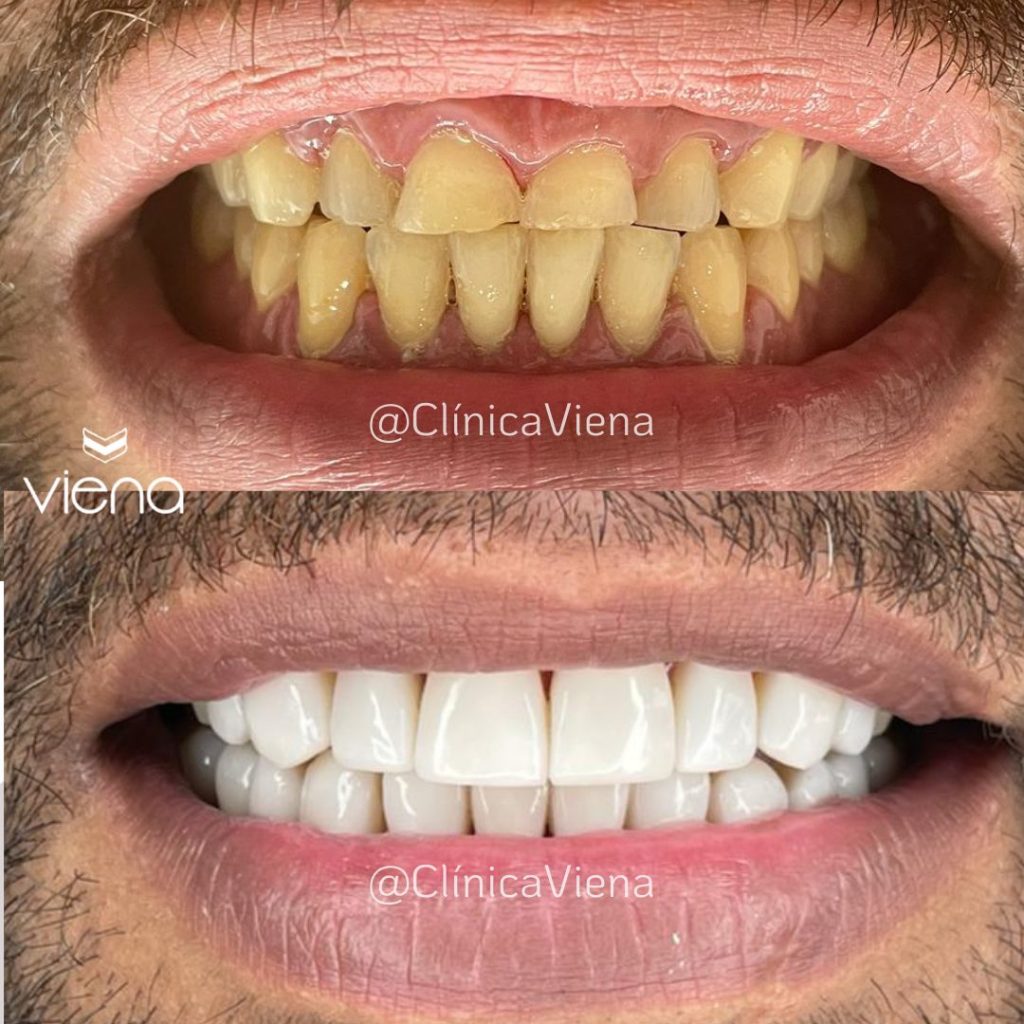
- Before: Chipped and stained teeth
- After: Smooth, white, and aligned smile

- Before: Gaps and uneven teeth
- After: Perfectly spaced and uniform teeth
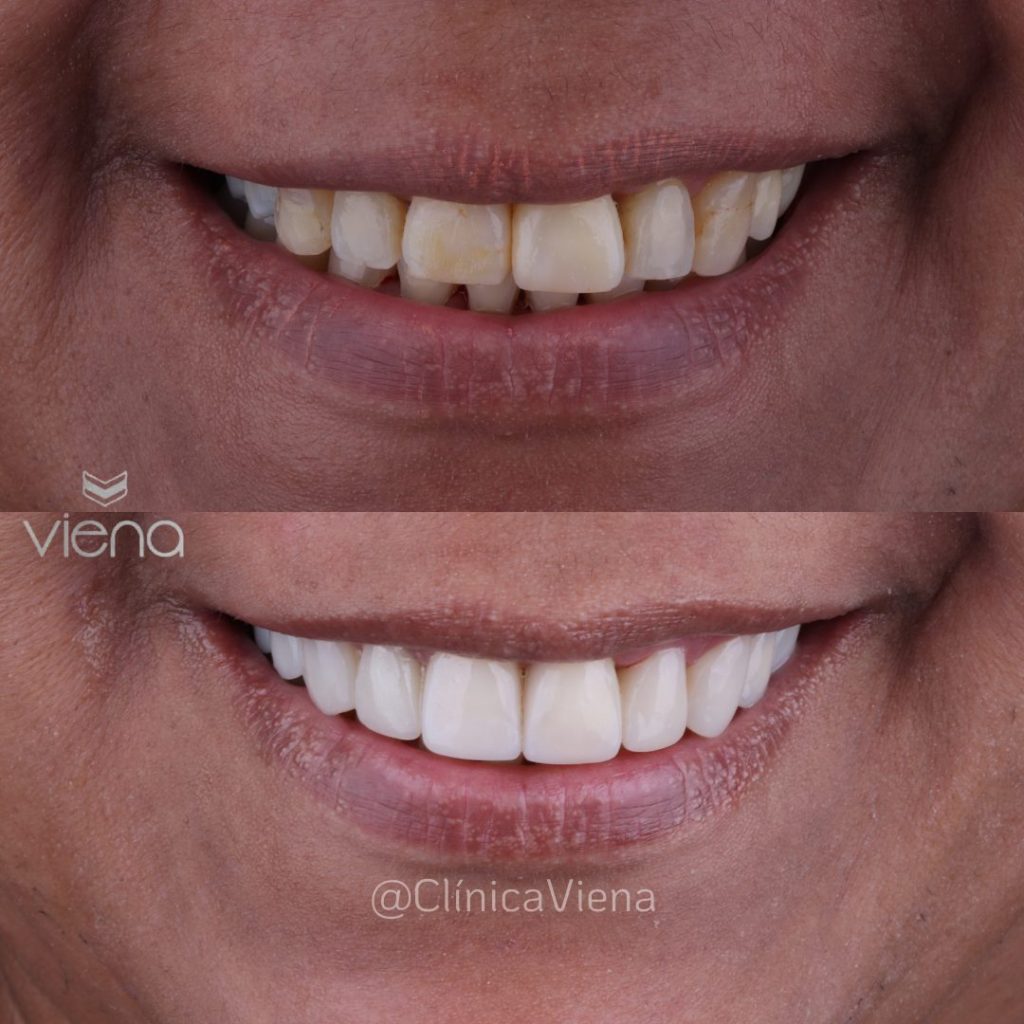
- Before: Worn and discolored teeth
- After: Natural-looking, bright smile

Dra. Sara Pelaez Monsalve
You might also be interested in:
Veneers After Braces: How Long to Wait and Who Is a Good Candidate
Thinking about veneers after braces? Most dentists recommend waiting 6...
Leer más
Can Veneers Fix Gap Teeth? A Cosmetic Dentist Explains
Gap teeth can be closed with veneers in as little...
Leer más
Do Veneers Stain? Porcelain vs. Composite Explained by a Cosmetic Dentist
Do veneers stain? Porcelain veneers rarely do, but composite veneers...
Leer más
Gummy Smile Treatment: 3 Real Options, One Right Answer for Your Case
Wondering if your gummy smile can be fixed? Dra. Sara...
Leer más